
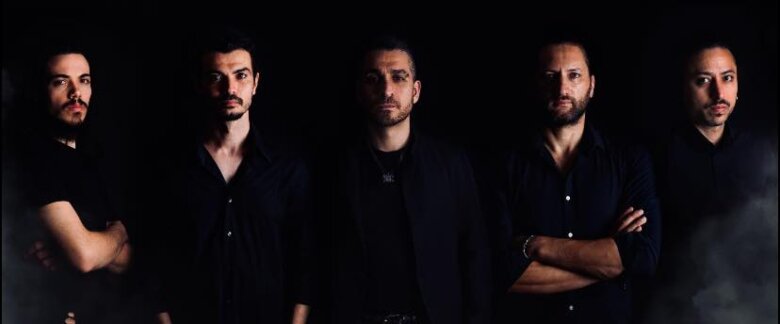
Pentesilea Road’s new album, Sonnets from the Drowsiness, is a journey between dream and reality—an atmospheric, emotionally charged exploration where delicate melodies meet heavy riffs, and silence speaks as loudly as sound.
We spoke with Vito F. Mainolfi about the inspirations behind the record, from literature and lucid dreaming to personal reflection, and how the band crafts its intricate, immersive soundscapes. The result is a record that invites listeners to feel, interpret, and get lost in its hazy, poetic world.
OFFICIAL LINKS
https://www.facebook.com/pentesilearoad
https://www.youtube.com/channel/UCKeoz8TsveQC6MOzQPysoKA
“Sonnets from the Drowsiness” is such an evocative title—what inspired it, and what does ‘drowsiness’ represent in the context of your music?
Hi all, Vito here—thanks for inviting us to this conversation. The album isn’t a concept record in the strict sense; it’s conceived as a collection of fragments. Much like our first album, this one is designed as a journey—except in Sonnets from the Drowsiness, that journey unfolds between dream and reality. That’s where the word “drowsiness” comes in.
“Drowsiness” isn’t about sleepiness—it’s that liminal space between waking and dreaming, where thoughts blur and emotions surface unfiltered. It’s the mental fog where vulnerability lives, and where art often finds its most honest voice.
Musically, it allowed us to explore contrasts—delicate melodies against heavy riffs, clarity against distortion. It’s a journey through emotional landscapes that aren’t always easy to articulate, but are deeply human. If you’ve ever felt suspended in that space between feeling too much and feeling nothing at all—that’s the drowsiness we’re singing from.

How does this album differ from your previous work, both musically and thematically?
Ah, that’s a great question. Sonnets from the Drowsiness marks a significant evolution from our debut. Thematically, the first album was more of a raw, emotional outpouring shaped by personal feelings and existential questioning. It was fragmented by design—a journey through space and time.
With Sonnets, we wanted to go deeper, but also more refined. There’s a narrative thread running through the album, even if it’s abstract. It’s about emotional inertia, the weight of memory, and the quiet battles we fight in our own minds.
Musically, we pushed ourselves further into progressive territory. The arrangements are more intricate, the dynamics more nuanced. We experimented with odd time signatures, layered textures, and a broader palette of sounds—from ambient passages to heavier, almost post-metal sections. But we never lost sight of melody. That’s always been our anchor.
I’d also say there’s more confidence in this record. We weren’t afraid to let silence speak, to stretch a moment, or to let a song breathe. It’s less about showing what we can do, and more about expressing what needs to be felt.
The record feels very atmospheric—what role do mood and texture play in your songwriting process?
Mood and texture are absolutely central to how I write music—they’re not just embellishments, they’re the emotional architecture of the song.
When I sit down to compose, I’m not thinking in terms of chords or riffs first. I’m chasing a feeling, a color, a temperature. Sometimes it’s the sound of a distant memory, other times it’s the weight of a thought I can’t shake.
Atmosphere gives the music its emotional gravity. It’s the difference between a song that sounds good and a song that feels necessary. I use layers—ambient sounds, subtle dissonances, dynamic shifts—to create that immersive space. It’s like painting with sound, where every brushstroke adds depth to the emotional canvas.
Also, the album was conceived during a time of isolation—during the height of COVID—and a time of personal loss, as described in “The Geometry of Nothing.”
Were there any particular books, films, or artworks that influenced the creation of Sonnets from the Drowsiness?
Yes, I must credit quite a few books and authors that inspired me. First of all, Daniel Love’s book on lucid dreaming gave me the initial idea for the album’s main theme. You’ll also find echoes of Calvino’s Invisible Cities, as in our first album.
Jeremy Bentham’s classic Panopticon is behind the song “Grave New World.” Beyond that, there are hints from many other authors. But mostly, I draw inspiration from everyday life.
The album title suggests a connection to poetry—how do literature and music intersect in your work?
For me, literature and music aren’t separate disciplines—they’re two sides of the same emotional coin. When I write music, I’m often thinking like a poet. I’m chasing metaphors, rhythms, cadences—not just in the lyrics, but in the structure of the songs themselves.
The title Sonnets from the Drowsiness is a direct nod to that. Sonnets are traditionally rigid in form, but rich in emotion. I loved the idea of taking that poetic discipline and applying it to something more fluid, more atmospheric.
Any book I read while composing might potentially influence the lyrics. I like to mix my interests—from technology to sociology and politics; from history to philosophy. You can even find a Fellini-like mood in there.
What was the most challenging song to complete on this album, and why?
Probably the instrumentals—especially “Mare Nostrum,” with its intricate arrangements and shifting time signatures. It was also challenging on the mixing side, since we recorded several layers of classical, acoustic, and electric guitars!
Could you walk us through your creative process when building the sonic landscapes of the record?
We don’t follow a specific pattern. I start by writing music based on the feelings of the moment, then try to give it a musical shape. After that, we refine everything together as a band.
I don’t particularly agree with the idea of following a fixed structure for a song or an album. Tension and release should come naturally, based on how the band feels it—not from a rulebook.
The same goes for the album’s dynamics and length. Pentesilea Road is conceived as a journey—a long one. Expecting the unexpected is part of its essence.
How has the audience reacted to Sonnets from the Drowsiness so far, and has anything surprised you about their feedback?
The response has been humbling, honestly. We knew we were diving into something more introspective, more atmospheric, and perhaps less immediate than our debut—but the way listeners have embraced that depth has been incredibly moving.
What’s surprised me most is how many people have connected with the emotional ambiguity of the record. Another unexpected joy has been seeing how differently people interpret the songs. Some hear hope in the haze, others hear despair. Some latch onto the sonic textures, others dissect the lyrics like poetry.
We conceived SFTD in a hermetic way, so listeners could find their own meaning in the songs—and that’s been amazing to witness. I’ve read interpretations that differ from my original intent, yet still make perfect sense. That kind of emotional dialogue is beautiful and surprising.
We’ve had occasional complaints about the album’s length, but that’s who we are as a band. It takes time to get into the mood, but I believe a careful listen will reward the listener. We wanted to create something that lasts—and I truly hope we did.
If the album were a journey or dream, what kind of imagery or places would listeners encounter along the way?
It would have all the characteristics of a dream—not linear, not logical, but deeply emotional. A dreamscape where every sound is a symbol, and every silence is a story.
I always encourage listeners to read the lyrics. I’m deeply convinced you can’t grasp the full message by listening to the music alone. Both sides are equally important in Pentesilea Road.
So, to answer your question: the listener might encounter whatever they truly feel in that strange place between dream and reality.
Looking ahead, do you see Sonnets from the Drowsiness as a self-contained chapter, or as the beginning of a new direction for Pentesilea Road?
Personally, I don’t like to plan too far ahead. I believe music should reflect a moment, a phase. Letting emotions speak is the most important thing.
I’m currently working on our third album, but it will be a collective effort again, so the timeline won’t be short. Ideally, we’ll remain on the same emotional and artistic coordinates moving forward.
Thanks again for having us and for the thoughtful questions.
Talk to you soon!
—Vito F. Mainolfi, Pentesilea Road
Comments